

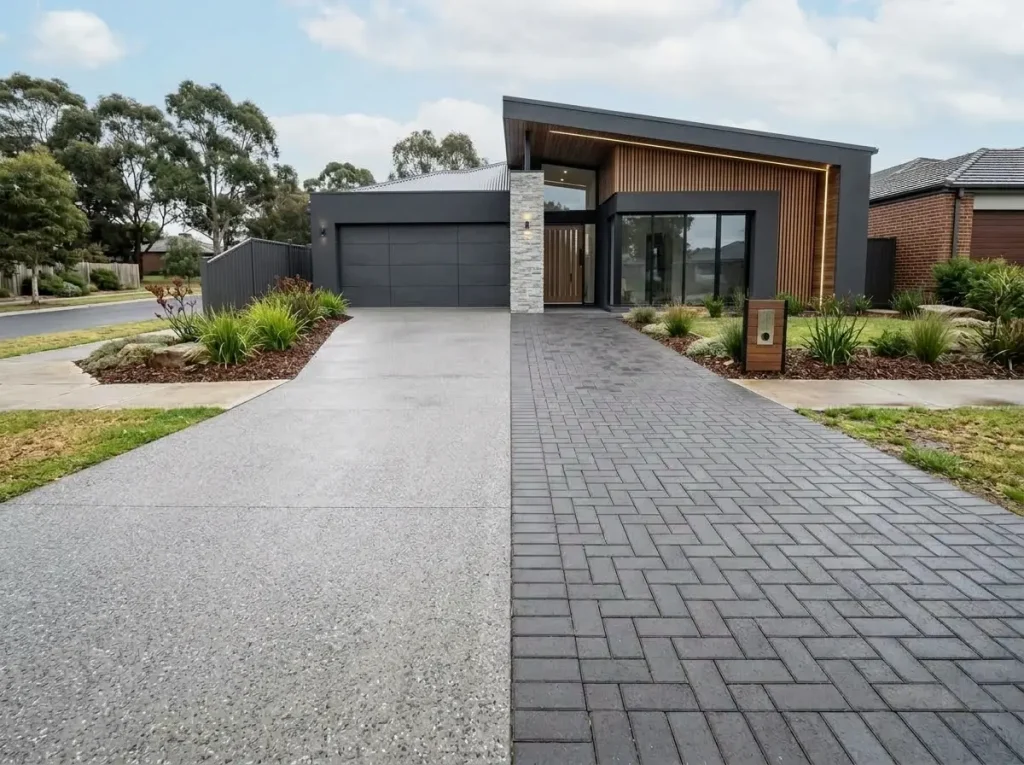
Choosing a new driveway involves more than deciding what looks best from the street. The surface needs to suit your home’s design, handle regular vehicle use, work with the property’s drainage and site conditions, and remain practical to maintain over time.
For Melbourne homeowners, concrete and pavers are two established driveway options, but they have different characteristics. Concrete provides a continuous, solid surface with a wide range of finish options, while pavers offer individual units that can be replaced or rearranged if sections become damaged.
So, when comparing concrete or pavers, which should you choose?
The answer depends on your property’s layout, drainage requirements, preferred appearance, maintenance expectations and project budget. This guide breaks down the key differences between a paver driveway vs concrete driveway to help you make a more informed decision.
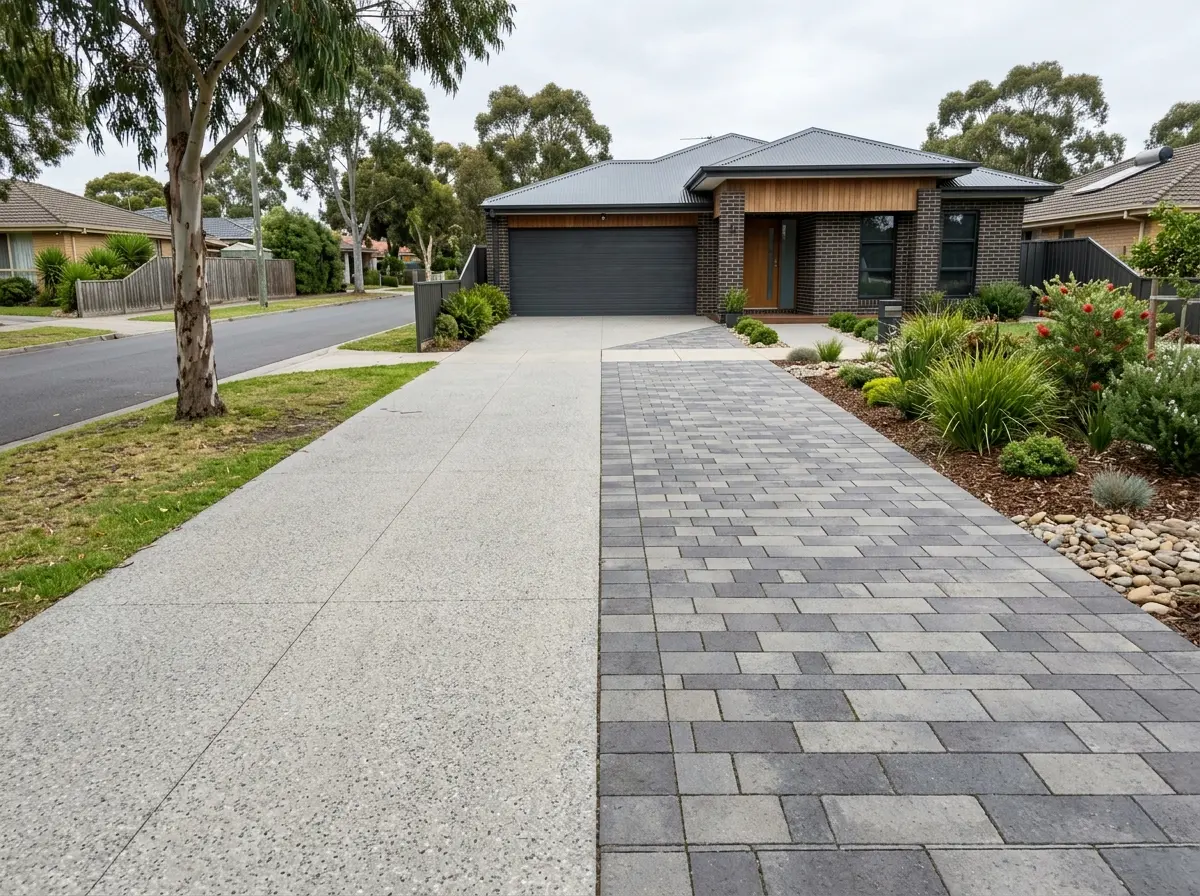
Concrete Driveways vs Paver Driveways at a Glance
| Factor | Concrete Driveway | Paver Driveway |
|---|---|---|
| Appearance | Available in plain, coloured, exposed aggregate, stamped and other finishes | Wide range of colours, shapes, materials and laying patterns |
| Maintenance | Generally straightforward, with a continuous surface | Requires attention to joints, weeds and occasional movement |
| Repairs | Cracks or significant damage can require more extensive repair | Individual damaged pavers can usually be replaced |
| Drainage | Requires careful falls and drainage planning because the surface is generally impervious | Permeable paving systems can provide water infiltration where designed for that purpose |
| Design flexibility | Strong range of colours, textures and decorative finishes | High flexibility through patterns, colours and combinations |
| Installation | Requires preparation, formwork, placement and curing | Requires careful base preparation and individual placement |
| Vehicle use | Suitable for residential vehicle access when appropriately designed and constructed | Suitable for vehicle access when correctly selected and installed |
| Upfront cost | Often competitive with standard paving, depending on finish and site conditions | Varies significantly with paver type, pattern and installation requirements |
There is no single material that suits every Melbourne driveway. The right choice comes down to how the driveway needs to perform as well as how you want it to look.
What Is a Concrete Driveway?
A concrete driveway uses a continuous concrete surface installed over a prepared base.
Traditional concrete does not have to mean a plain grey slab. Depending on the project, homeowners can consider different finishes, colours and decorative treatments.
Common options can include:
- Plain concrete
- Coloured concrete
- Exposed aggregate
- Stencilled concrete
- Stamped or patterned finishes
Concrete can therefore work with both contemporary and more traditional residential exteriors.
NAXAN’s current residential concreting projects demonstrate how concrete can be used for vehicle access as well as broader outdoor improvements. Its published Residential Concrete Driveway Construction project, for example, involved preparing an uneven access area, establishing driveway formwork and installing a finished concrete surface leading towards the garage.
What Is a Paver Driveway?
A paver driveway is constructed from individual paving units installed across a prepared base.
Depending on the design, pavers can provide considerable flexibility in:
- Colour
- Shape
- Size
- Pattern
- Border detailing
- Material selection
- Surface texture
One practical characteristic of pavers is that the driveway is made up of individual units rather than one continuous slab.
This can be useful when repairs are required. If an individual paver becomes damaged, it can potentially be removed and replaced without removing the entire driveway surface.
However, that flexibility also means the installation requires careful preparation and accurate placement. Poor preparation can contribute to movement or unevenness over time.
Concrete or Pavers: Which Is More Durable?
Both concrete and pavers can be suitable for residential vehicle access when correctly designed and installed.
The important point is that the material alone does not determine driveway performance.
Factors such as:
- Ground conditions
- Base preparation
- Drainage
- Vehicle loading
- Surface design
- Installation quality
- Ongoing maintenance
can all affect how a driveway performs.
Concrete durability
Concrete provides a continuous surface and can be highly durable for residential driveways. However, concrete can crack as it ages or when ground movement, poor preparation, drainage problems or other stresses affect the slab.
Paver durability
Pavers can also provide a durable driveway surface. One advantage is that individual units can generally be replaced rather than repairing an entire continuous slab when localised damage occurs.
The underlying preparation remains important. A quality paver installation still depends on a properly prepared and stable base.
Bottom line: both materials can provide long-term driveway performance, but the site’s conditions and quality of installation are critical.
Paver Driveway vs Concrete: Maintenance
Maintenance is another important difference.
Concrete maintenance
A concrete driveway generally has fewer joints than a traditional paver driveway, which can make routine cleaning relatively straightforward.
Depending on the finish and exposure, homeowners may need to address:
- Surface staining
- Dirt and debris
- Cracking
- Surface wear
- Drainage issues
The appropriate maintenance approach will depend on the concrete finish and condition.
Paver maintenance
Paver driveways can require more attention around the joints between individual units.
Potential maintenance can include:
- Removing weeds
- Cleaning joints
- Replacing damaged pavers
- Addressing movement or settlement
- Re-leveling sections where required
The advantage is that localised repairs can be relatively targeted. Instead of replacing a large continuous surface, individual damaged pavers may be removed and replaced.

Which Looks Better: Concrete or Pavers?
This largely comes down to the style of your home.
Concrete can provide a clean, continuous appearance and can be customised through different finishes.
Pavers provide a more segmented appearance, with the joints and laying pattern becoming part of the driveway’s design.
For example, a homeowner wanting a simple contemporary frontage may prefer a clean concrete finish, while another property may suit a patterned paver layout with contrasting borders.
Neither material is automatically more attractive.
The better question is:
Which surface complements the architecture, landscaping and frontage of your property?
A driveway should feel connected to the rest of the home’s exterior rather than looking like a separate addition.
Which Is Better for Driveway Drainage?
Drainage should be considered before choosing a driveway surface.
A standard sealed concrete driveway is generally an impervious surface, meaning water does not simply infiltrate through it. The driveway therefore needs appropriate falls and drainage planning so stormwater is directed safely.
Victoria’s planning guidance specifically identifies driveways and sealed outdoor paved areas among impervious surfaces and highlights the importance of maintaining permeable areas for water absorption.
Paving can also be installed as a conventional sealed surface, so simply choosing pavers does not automatically mean better drainage.
However, appropriately designed permeable paving systems can allow water to infiltrate through the surface and underlying system.
That distinction matters.
If stormwater management is an important consideration for your property, discuss the proposed driveway construction, drainage and surface system before installation rather than choosing a material based only on appearance.
Are Pavers More Expensive Than Concrete?
There is no single price difference that applies to every driveway.
The final cost can be affected by:
- Driveway size
- Site access
- Existing surface removal
- Ground preparation
- Excavation
- Base requirements
- Drainage
- Material selection
- Paver type
- Laying pattern
- Concrete finish
- Edging and borders
- Site levels
- Labour requirements
Standard concrete can be more economical than some paving options, while decorative concrete can narrow the difference depending on the finish selected. Australian trade guidance also notes that the comparison depends heavily on the particular concrete and paver products and installation requirements being considered.
For that reason, it is better to compare like-for-like quotes rather than assuming that either material will always be cheaper.
Concrete vs Pavers: Repair Considerations
Repairs are one of the clearest practical differences between the two surfaces.
If concrete is damaged
Small cracks or surface issues may sometimes be repairable, depending on their cause and severity.
More significant cracking or structural deterioration can require more extensive work.
If a paver is damaged
A damaged individual paver can generally be removed and replaced with another matching unit.
This can make localised repairs more manageable.
However, replacement pavers need to match the existing product as closely as possible, and the underlying reason for the damage should also be considered.
If repeated movement is caused by a problem with the base, simply replacing the visible paver will not necessarily solve the underlying issue.
What About Melbourne’s Conditions?
Melbourne properties can present very different driveway conditions from one site to another.
Before choosing a surface, consider:
Existing ground conditions
The condition and stability of the existing ground can affect preparation requirements.
Site levels
The driveway needs to connect appropriately with the street, garage, paths and surrounding areas.
Stormwater
Drainage should be considered as part of the overall driveway design.
Property frontage
The driveway is one of the first visible elements of a home, so its colour, texture and pattern should work with the property’s exterior.
Vehicle requirements
Consider how many vehicles will use the driveway and whether heavier vehicle access is expected.
Existing landscaping
Trees, garden beds, retaining walls, fencing and paths can all influence the available driveway layout.
What Should You Consider Before Choosing a Driveway Material?
Before deciding between concrete and pavers, ask:
1. What appearance suits the house?
Look at the home’s brickwork, render, roof, fencing and landscaping.
2. How much maintenance are you comfortable with?
Think about cleaning, joints, weeds, staining and future repairs.
3. What are the drainage requirements?
Consider where rainwater will flow and whether a permeable solution is appropriate.
4. What is the condition of the existing ground?
The driveway may require excavation, preparation or removal of an existing surface before installation.
5. What is your actual project budget?
Compare complete installation quotes rather than the surface material alone.
6. How will the driveway be used?
Regular residential car access has different requirements from a surface that may occasionally carry heavier vehicles.
7. How does the driveway connect to the property?
The finished driveway should work with the garage, front path, street crossing and surrounding landscaping.
Concrete vs Pavers Driveway: Which One Should You Choose?
The decision can be simplified by thinking about your priorities.
Concrete may suit you if you prioritise:
- A continuous surface
- Straightforward routine maintenance
- A clean modern appearance
- Different decorative finish options
- A practical residential vehicle surface
Pavers may suit you if you prioritise:
- Individual design elements
- Patterns and borders
- A wide selection of paving styles
- The ability to replace individual units
- Potentially permeable paving systems where appropriate
This does not mean that concrete is always the better choice for low maintenance or that pavers are always the better choice for repairs. The actual product, installation method and site conditions matter.
Concrete or Pavers: Why Installation Matters
Whichever surface you choose, the quality of the preparation underneath it is fundamental.
A driveway project may involve:
- Assessing the existing site
- Removing or preparing the existing surface
- Establishing levels and drainage requirements
- Preparing the base
- Defining the driveway layout
- Installing the selected surface
- Finishing and checking the completed area
NAXAN’s published driveway concreting projects show this preparation-led approach. Its Concreting Driveway Project involved clearing and preparing the existing driveway, levelling the ground, installing timber formwork and then placing and finishing the concrete.
NAXAN has also published a residential project combining driveway and backyard concreting, where the concrete areas were planned around the existing home, property boundaries and vehicle access.
Do You Need Approval for a Melbourne Driveway?
Do not assume that every driveway project has the same approval requirements.
The Victorian Building and Plumbing Commission states that a building permit is not required for constructing a driveway or laying paving, while also noting that driveway and paving work can interact with drainage and plumbing.
Planning requirements can be different. Victorian Government guidance explains that planning schemes regulate development and that permit requirements depend on the particular property and proposal.
For that reason, homeowners should check the requirements applying to their specific property and local council before work begins.
How NAXAN Approaches Residential Driveway Projects
NAXAN Renovations provides residential concreting and driveway-related construction services across Melbourne.
Its published project portfolio includes concrete driveway construction, driveway concreting and exposed aggregate concreting projects.
The company’s published Vehicle Crossing & Exposed Aggregate Concreting project, for example, combined a new vehicle crossing with an exposed aggregate driveway extending towards the property.
For homeowners considering a driveway upgrade, the important starting point is not simply choosing between two materials. The project should be considered as a whole — including the property’s existing conditions, access, drainage, layout, appearance and intended use.
Final Thoughts: Concrete or Pavers?
There is no universal winner in the concrete vs pavers driveway comparison.
Concrete can provide a practical continuous surface with a range of finish options, while pavers offer design flexibility and the ability to replace individual units when localised damage occurs. Drainage, maintenance, installation requirements and cost can vary considerably depending on the specific system selected.
For a Melbourne home, the best starting point is to assess the site, drainage, vehicle use, appearance, maintenance expectations and overall project budget together.
If you’re planning a new driveway or replacing an existing surface, NAXAN Renovations can help assess the practical requirements of your project and discuss suitable concreting and driveway options.

